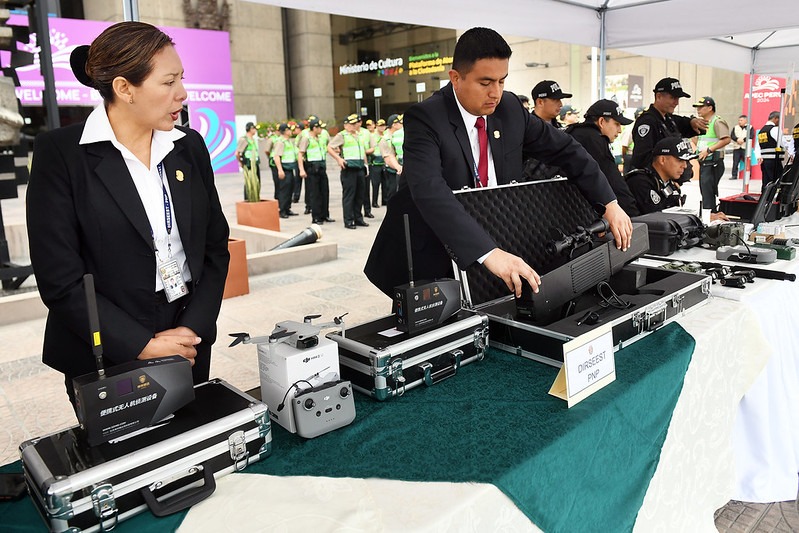
Jan 1, 2026 — Third Meeting of the Mexico–U.S. Security Implementation Group: Collaborative Threat Assessment : Mexico and the United States are actively working together to advance their understanding of the global threats posed by unmanned systems as a core part of their joint security agenda. Focus on Detection and Mitigation : Operational cooperation includes sharing practical experiences with drone detection and mitigation exercises, which took place during a visit to the Unmanned Technology Operations Center (UTOC). Multi-Agency Strategic Involvement : Mexico’s approach to unmanned technology involves a coordinated inter-agency effort, including high-level representatives from the Ministry of Defense (SEDENA), the Navy (SEMAR), and intelligence and police research sectors.
Secretary of External Relations, Mexico
Sep 1, 2025 — Persistent Threats: How Human Smugglers Are Exploiting Drone Technology Along the U.S.-Mexico Border: Criminal Adaptation and Precision Operations : Mexican cartels and Alien Smuggling Organizations (ASOs) have transitioned from high-volume smuggling to precision operations by integrating small Unmanned Aerial Systems (sUAS) into their tactics. These groups use drones for real-time surveillance of border patrols, allowing them to guide illegal crossings via live video feeds and gain an asymmetric advantage over traditional law enforcement. Flexible Counter-UAS Deployment in Mexico : Unlike the United States, which the source describes as having outdated regulatory frameworks, Mexican security forces at the local, state, and federal levels have already embraced a more flexible mindset toward counter-drone capabilities. It is now common for Mexican law enforcement units to be equipped with C-sUAS tools specifically to protect against cartel-operated drones used for surveillance and targeted attacks. Bilateral Strategic Cooperation : There is a growing emphasis on formalizing international partnerships to manage the drone threat. The source recommends the creation of a dedicated US-Mexico counter-drone program that would involve the Mexican National Guard—the lead agency for border enforcement—and state police forces to establish a joint mechanism for detecting and neutralizing drone activity.
Jack D. Gordon Institute for Public Policy, Florida International University
Jul 1, 2025 — DQUISICIÓN DE SISTEMA MÓVIL DE ANTIDRONES MONTADOS EN VEHÍCULOS TIPO VAN, SISTEMA FIJO DE ANTIDRONES, SISTEMA ESPECIALIZADO EN DETECCIÓN E INHIBICIÓN DE DRONES Y SISTEMA DE VIGILANCIA ÁEREO NO TRIPULADA (ACQUISITION OF MOBILE ANTI-DRONE SYSTEMS MOUNTED ON VAN-TYPE VEHICLES, FIXED ANTI-DRONE SYSTEM, SPECIALIZED SYSTEM FOR DRONE DETECTION AND JAMMING, AND UNMANNED AERIAL SURVEILLANCE SYSTEM): Integrated Multi-Layered Defense : The acquisition strategy involves a mix of fixed and mobile C-UAS systems to provide wide-area protection. By combining fixed installations with mobile units mounted on specialized vans, the state can protect static infrastructure while maintaining the flexibility to deploy anti-drone capabilities to different high-priority locations as needed. Technological Focus on Detection and Inhibition : The source specifies highly technical requirements for RF (Radio Frequency) detection and jamming, specifically citing systems like the DroneSentry-X MK2 and Skyfend SFL100. These systems must be capable of detecting threats from 3 to 5 kilometers away and inhibiting drone communication frequencies across multiple bands, including 2.4 GHz, 5.8 GHz, and GNSS signals. Simultaneous Adoption of UAS for Surveillance : Alongside counter-measures, the tender includes the purchase of specialized surveillance drones, such as the Matrice 4T, equipped with thermal infrared cameras, laser rangefinders, and high-resolution zoom capabilities. This demonstrates that regional security efforts are not just focused on stopping drones, but also on leveraging UAS for advanced aerial intelligence and monitoring.
Secretary of Planning, Finances and Administration, Mexico
Jun 1, 2025 — Mexican police in Chiapas unveil armed drones to combat cartels: Emergence of Armed UAS by Law Enforcement: State police in Chiapas, Mexico, have recently unveiled a fleet of armed drones designed to combat heavily armed drug cartels. These drones are versatile, with the capability to be equipped with firearms for tactical operations or tools for firefighting. Asymmetric "Arms Race" with Cartels: Mexican authorities are currently in an "arms race" to catch up with cartels that frequently use drones to drop improvised explosive devices (IEDs). Between 2020 and mid-2023, there were over 600 recorded attacks by drones equipped with explosives in Mexico, primarily in states like Guerrero and Michoacán. Operational Risks and Diplomatic Friction: The use of advanced UAS and pursuit of gunmen has led to international incidents, such as when Chiapas police entered neighboring Guatemala during a shootout. While these drones enhance surveillance and tactical capabilities, their rules of engagement remain undefined, raising concerns about potential escalation and the lack of clear policy frameworks in the region.
Associated Press (AP News)
Jan 19, 2025 — El Gabinete de Seguridad del Gobierno de México informa acciones relevantes de los días 17, 18 y 19 de enero de 2025 (The Security Cabinet of the Government of Mexico reports relevant actions of January 17, 18 and 19, 2025): Active Interdiction of Anti-Drone Technology : Mexican security forces are actively seizing specialized counter-UAS hardware from criminal cells. In Teloloapan, Guerrero, the Mexican Army and National Guard recovered two units of anti-drone equipment alongside radio communication gear and weaponry. Dismantling of Illegal Surveillance Networks : Efforts to control the tactical environment include the removal of unauthorized surveillance infrastructure that complements drone usage. In Chiapas and Veracruz, authorities uninstalled 48 illegal video vigilance cameras and several control panels used by criminal groups to monitor territory. Seizure of Materials for Aerial Kinetic Attacks : The source documents the widespread recovery of improvised explosive devices (IEDs). Notable seizures included 60 IEDs in Michoacán, 45 in Escuinapa, and 10 in Fresnillo, signaling a high volume of explosive material available for non-state tactical use.
Secretary of Security and Citizen Protection, Mexico
Jan 1, 2025 — EQUIPOS Y APARATOS DE COMUNICACIONES Y TELECOMUNICACIONES (COMMUNICATIONS AND TELECOMMUNICATIONS EQUIPMENT AND APPARATUS): Mandatory Licensing and Registration : The Peruvian government, through the Ministry of Transport and Communications (MTC) and the General Directorate of Civil Aeronautics (DGAC), requires all non-recreational or non-sporting drone operators to obtain a pilot license. Additionally, the state maintains a public and free registry of all aircraft and their owners to ensure accountability and safety. Operational Restrictions and Sanctions : To protect public safety and privacy, the law strictly prohibits flying over high-density urban areas, protected natural areas, or restricted zones without exceptional authorization. Violating citizen privacy or endangering manned flight operations can lead to fines and administrative sanctions as determined by the DGAC. Support for Research and Technological Innovation : The legislation actively promotes the development of UAS technology by establishing specific geographical zones for testing and scientific research. To further encourage innovation, the government offers tax benefits for RPAS-related projects that are qualified as scientific or technological research by CONCYTEC.
Subcommittee of Acquisitions for the public security, Michoacan de Ocampo, Mexico
Oct 1, 2024 — Mexico’s Narco Tanks Are Going From Impractical to Tactical: Integration of Signal Inhibitors : The newest generation of narco tanks features signal inhibitor systems specifically designed to disrupt and neutralize drones. This represents a significant technological leap from earlier, more primitive versions of these vehicles, shifting their purpose from mere protection to active electronic warfare on the battlefield. Enhanced Situational Awareness : To complement their defense against aerial and ground threats, these vehicles are now equipped with closed-circuit television (CCTV) cameras. These systems provide operators with 360-degree vision from inside the armored hull, allowing them to monitor their surroundings without exposing themselves to sniper fire or drone-delivered explosives. Tactical Evolution of Non-State Actors : The use of these technologies by groups like the Jalisco Cartel New Generation (CJNG) demonstrates an evolution from using tanks as symbolic "status symbols" to employing them as functional tactical weapons. By utilizing lighter, military-grade steel illegally imported from the United States, these groups are creating more mobile units capable of supporting sophisticated electronic equipment.
Insight Crime
Jul 1, 2024 — Sedena planea adquirir sistemas antidrones para frenar ataques del narco en seis estados del país (Mexico's Army plans to acquire anti-drone systems to curb drug cartel attacks in six states): Integrated Procurement of UAS and C-UAS : Sub-national governments in Latin America are seeking to bolster security by simultaneously acquiring high-end surveillance drones and the means to disable them. This tender specifically requires a "New Generation Drone" equipped with a Starlight night vision camera (H20N) alongside a "Portable Anti-Drone System" designed for detection and countermeasures. Emphasis on Portable Counter-Drone Capabilities : The source highlights a demand for all-in-one portable C-UAS technology that can detect and jam conventional drones operating on 2.4 GHz and 5.8 GHz frequencies. The specified system must be capable of radio detection and frequency jamming within a 1 km range, allowing security forces to visualize and control the airspace in real-time. Mandatory Operational Training and Certification : UAS/C-UAS efforts include a heavy focus on professionalization and training for security personnel. The winning provider is contractually obligated to implement a training course for operators that includes 30% theoretical and 70% practical instruction, led by instructors certified by a federal civil aviation agency.
Infobae
Sep 1, 2022 — A Cartel Bodyguard in Mexico’s ‘Hot Land’: Offensive Deployment of Weaponized Drones : The Jalisco New Generation Cartel (CJNG) utilizes drones to conduct aerial strikes against rival positions. These drones are modified to drop .60 mm grenades that are fashioned to detonate on impact. These aerial attacks target makeshift trenches and barricades, with the grenades capable of hitting targets within a 30-meter radius. This tactic forces rival soldiers into a state of "heightened alert," causing mental exhaustion as they must constantly listen for the low humming sound of approaching drones. Rudimentary Counter-UAS (C-UAS) Tactics : Rival factions, such as the United Cartels (Cárteles Unidos), rely on manual detection and small arms fire to neutralize aerial threats. When a drone is spotted, soldiers alert the group by screaming "Drone! Drone! Drone!" to signal others to take cover. Soldiers then attempt to shoot down the UAS using assault rifles. Successfully downing a drone is a significant morale booster, often marked by "celebratory yells" from the fighters. Intelligence and Propaganda Value : UAS serve a dual purpose for cartels as tools for intelligence gathering and media warfare. When a drone is shot down, groups prioritize retrieving it to examine its camera footage and determine if it was gathering intelligence on their movements or positions. Additionally, cartels use captured or downed drones as propaganda, showcasing them to media outlets that chronicle the conflict to demonstrate their success in neutralizing rival technology.
Insight Crime
Sep 1, 2020 — El presente apartado contiene las ligas a la Norma Oficial Mexicana NOM 107 SCT3 2019. (This section contains links to the Official Mexican Standard NOM 107 SCT3 2019.): Established Legal Framework : Mexico has implemented a specific official standard, NOM-107-SCT3-2019, which establishes the mandatory requirements for operating RPAS (drones) within Mexican airspace. Mandatory Pre-Operation Registration : Operators are required to register their drones with the Mexican Aeronautical Registry before beginning any flight operations. This process is managed online through the Federal Civil Aviation Agency (AFAC) to ensure all active drones are accounted for by the aeronautical authority. Strict Ownership Verification : The registration process requires high levels of accountability, requiring operators to submit proof of legal ownership or possession, along with digital copies of official identification for individuals or articles of incorporation for legal entities.
Civil Aviation Agency, Mexico
Oct 1, 2019 — NORMA Oficial Mexicana NOM-107-SCT3-2019, Que establece los requerimientos para operar un sistema de aeronave pilotada a distancia (RPAS) en el espacio aéreo mexicano. (Official Mexican Standard NOM-107-SCT3-2019, which establishes the requirements to operate a remotely piloted aircraft system (RPAS) in Mexican airspace.): Comprehensive Legal Classification and Integration : Mexico has established the Official Mexican Standard NOM-107-SCT3-2019 to regulate the operation, registration, and commercialization of RPAS within its airspace. The standard categorizes these systems by Maximum Take-Off Weight (MTOW) into three distinct groups—Micro (≤ 2 kg), Small (> 2 kg to 25 kg), and Large (> 25 kg)—with varying levels of requirements for training, pilot licensing, and airworthiness depending on whether the use is recreational, private non-commercial, or commercial. This framework is designed to integrate RPAS safely into non-segregated airspace alongside manned aircraft. Strict Operational Safety and Security Prohibitions : To protect public safety and national security, the regulation imposes rigorous geographic restrictions, such as requiring a minimum distance of 9.2 km from airports and 0.9 km from heliports for most operations. Furthermore, the standard explicitly prohibits the use of RPAS for transporting dangerous goods, prohibited substances, weapons, or explosives. Pilots are also restricted from operating in prohibited or restricted areas defined in aeronautical publications (PIA/AIP) without special authorization. Emphasis on Detection and Interference Protection : The source outlines specific security-oriented technological requirements and reporting mechanisms. It highlights the long-term goal of integrating detection and avoidance technologies and protecting communication spectra against unintentional or unlawful interference. Large RPAS are specifically required to have devices for automatic identification and systems that limit operation in prohibited zones. Additionally, the regulation encourages the immediate reporting of RPAS sightings around airports and heliports to the Aeronautical Authority to manage potential risks.
Official Federal Journal, Mexico