
Topics / Spotlights
Small Arms and Light Weapons (SALW) Trafficking
Illicit Small Arms and Light Weapons (SALW) Trafficking refers to the unauthorized production, transfer, possession, or circulation of firearms and related equipment in violation of national or international regulations:
Illicit manufacture refers to the production or assembly of firearms, ammunition, or related parts without a proper license or authorization, often conducted outside state oversight.
Illicit transfer refers to the import, export, or transit of SALW in contravention of national laws or international arms control agreements, including transfers to non-state actors or conflict zones.
Illicit possession refers to the unauthorized holding or stockpiling of SALW by individuals, criminal groups, or insurgents in violation of national laws or disarmament agreements.
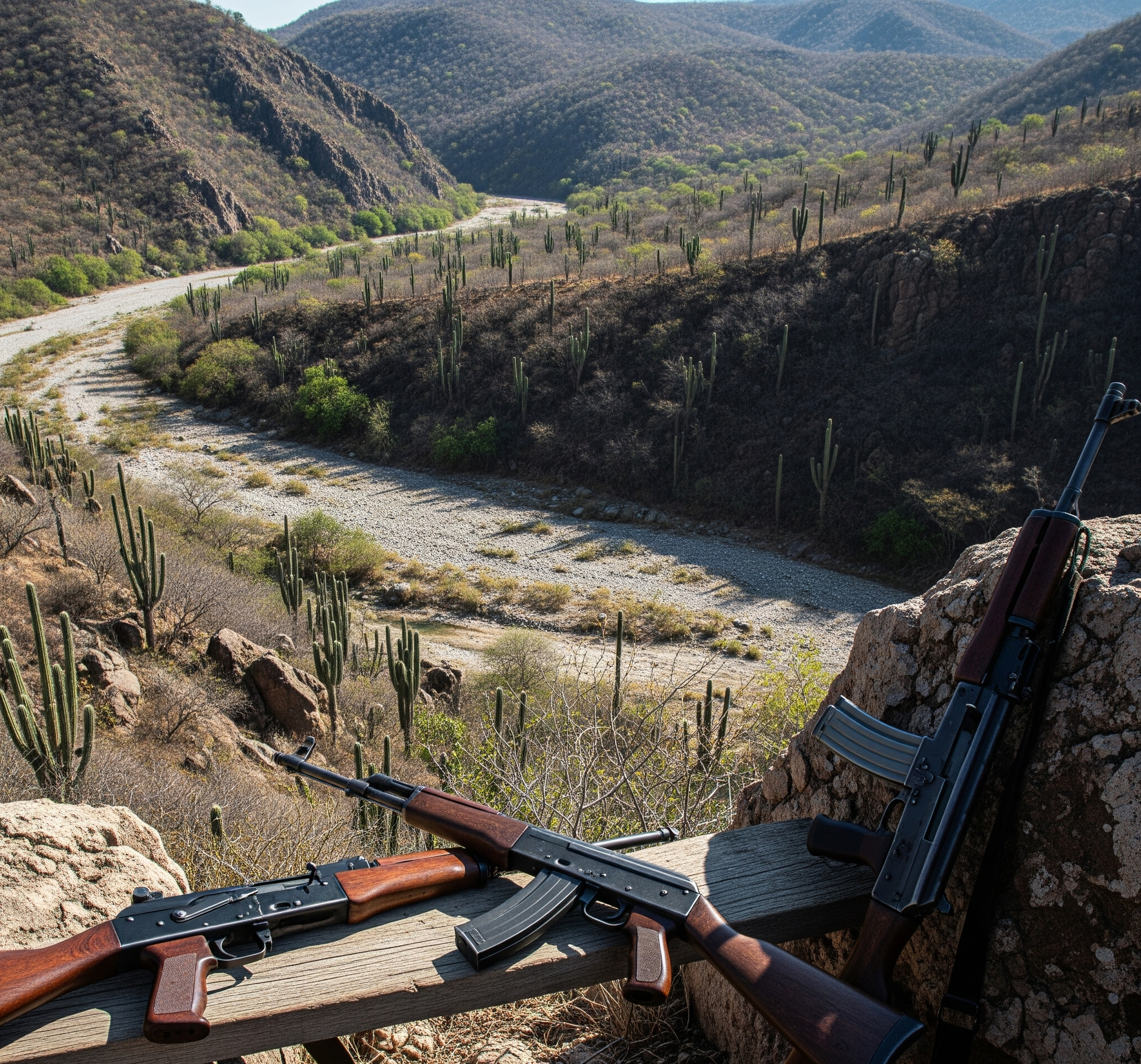
Beyond the direct threat to human life, SALW trafficking is a major security challenge that fuels armed violence, destabilizes regions, and undermines state authority. This is especially acute in Latin America and the Caribbean, where high rates of firearm-related violence, porous borders, and the influence of transnational criminal organizations have made the region particularly vulnerable to the illicit proliferation of weapons. It contributes to prolonged conflict, enables transnational organized crime, and weakens development and governance efforts, particularly in fragile and post-conflict states. Like other forms of illicit transnational flows, SALW trafficking often intersects with other criminal enterprises, including drug trafficking, terrorism, and human smuggling.
Explore our research
Find our latest publications, story maps, and technical resources.
Dashboards
Apr 16, 2025Small Arms, Light Weapons Dashboard
The Small Arms, Light Weapons (SALW) Dashboard is an ArcGIS dashboard that synthesizes data on arms seizures, thefts, and usages across Latin America. The dashboard was made in collaboration with the Regional Coordinator for Economic and Social Research (CRIES) and FIU’s GIS Center.
Sofia Molina, Andrei Serbin Pont | Source: FIU Digital Commons
Sofia Molina, Dr. Andrei Serbin Pont | Source: FIU Digital Commons
Camila Rojas, Dr. Andrei Serbin Pont | Source: FIU Digital Commons
Sofia Molina, Dr. Andrei Serbin Pont | Source: FIU Digital Commons
Andrei Serbin Pont | Source: FIU Digital Commons
Andrei Serbin Pont | Source: FIU Digital Commons
Andrei Serbin Pont | Source: FIU Digital Commons
This report focuses on firearms recovered and traced in 2024 from five Caribbean countries: The Bahamas, Dominican Republic, Haiti, Jamaica, and Trinidad and Tobago. Traces are organized by the year of recovery—not the year the trace was initiated—to better capture trends. If no recovery date is available, the trace is categorized by the year it was entered into ATF’s Firearms Tracing System.
Key criteria for the analysis include excluding duplicates, including only traces from 2024, and using data current as of March 10, 2025. Not all traces may have been completed at the time of analysis, and minor discrepancies may exist due to rounding.
Bureau of Alcohol, Tobacco, Firearms and Explosives | Source: Bureau of Alcohol, Tobacco, Firearms and Explosives
This report focuses on firearms recovered and traced in 2023 from five Caribbean countries: The Bahamas, Dominican Republic, Jamaica, Saint Lucia, and Trinidad and Tobago. Traces are organized by the year of recovery—not the year the trace was initiated—to better capture trends. If no recovery date is available, the trace is categorized by the year it was entered into ATF’s Firearms Tracing System.
Key criteria for the analysis include excluding duplicates, including only traces from 2023, and using data current as of March 11, 2024. Not all traces may have been completed at the time of analysis, and minor discrepancies may exist due to rounding.
Bureau of Alcohol, Tobacco, Firearms and Explosives | Source: Bureau of Alcohol, Tobacco, Firearms and Explosives
This report focuses on firearms recovered and traced in 2022 from five Caribbean countries: The Bahamas, Barbados, Dominican Republic, Jamaica, and Trinidad and Tobago. Traces are organized by the year of recovery—not the year the trace was initiated—to better capture trends. If no recovery date is available, the trace is categorized by the year it was entered into ATF’s Firearms Tracing System.
Key criteria for the analysis include excluding duplicates, including only traces from 2022, and using data current as of March 10, 2023. Not all traces may have been completed at the time of analysis, and minor discrepancies may exist due to rounding.
Bureau of Alcohol, Tobacco, Firearms and Explosives | Source: Bureau of Alcohol, Tobacco, Firearms and Explosives
Between 2018 and 2022, the Bureau of Alcohol, Tobacco, Firearms and Explosives (ATF) traced 7,399 firearms recovered in the Caribbean, with 73 percent found to have come from the U.S.—mostly handguns. As Caribbean nations do not manufacture firearms, weapons are smuggled in by air and sea using various concealment methods and often circulate through illicit markets.
GAO conducted site visits and interviews with officials from the U.S. and six Caribbean nations. Based on its findings, GAO recommended that the U.S. Department of State update the Caribbean Basin Security Initiative (CBSI) Results Framework to include indicators specific to firearms trafficking. The State Department agreed with the recommendation.
United States Government Accountability Office | Source: United States Government Accountability Office
Leveraging new data sources, this report examines the prevalence and patterns of arms trafficking within and between each of the four subregions. Recognizing the nature of the threat arms trafficking presents to the Western Hemisphere at large, the report seeks to define the contours of a new strategy to combat illegal guns, concluding with recommendations for the United States, Mexico, Central America, South America, and the Caribbean to pursue.
Christopher Hernandez-Roy, Henry Ziemer, Azucena Duarte | Source: Center for Strategic & International Studies
Mark Ungar | Source: Cambridge University Press